> ## Documentation Index
> Fetch the complete documentation index at: https://docs.thoras.ai/llms.txt
> Use this file to discover all available pages before exploring further.
# Predictive Vertical Pod Rightsizing
> Predictive Vertical Pod Rightsizing is the process of preemptively optimizing the CPU and memory resource requests and limits for Kubernetes pods to ensure they have just enough resources to run efficiently without over or under provisioning. Unlike horizontal scaling, which adjusts the number of pod replicas, vertical rightsizing focuses on tuning individual pod configurations to better match their actual usage patterns. This helps reduce wasted resources, lower cloud costs, and improve cluster utilization, while also minimizing the risk of resource starvation or out-of-memory (OOM) errors.
**In-place pod resize on Kubernetes 1.33+.** When running on Kubernetes 1.33
or later, Thoras applies CPU and memory adjustments without restarting pods,
eliminating the rollout churn historically required by vertical autoscalers.
Thoras falls back to a rolling restart automatically on older clusters or
when an in-place resize is not supported (for example, a QoS class change).
See [Update Policy](#update-policy) for details.
## Prerequisites
Before you begin, make sure:
* Thoras is installed and running in your Kubernetes cluster.
* The
[Kubernetes Metrics Server](https://github.com/kubernetes-sigs/metrics-server)
is installed in your cluster.
* Your workloads are instrumented with resource requests and have some usage
history.
## Sample Configuration
Here's an example `AIScaleTarget` that configures rightsizing.
```yaml ast.yaml theme={null}
apiVersion: thoras.ai/v1
kind: AIScaleTarget
metadata:
name: {{YOUR_AST_NAME}}
namespace: {{YOUR_NAMESPACE}}
spec:
scaleTargetRef:
kind: Deployment
name: {{YOUR_DEPLOYMENT_NAME}}
model:
forecast_blocks: 4h
forecast_interval: 1h
forecast_buffer_percentage: 0%
mode: balanced
vertical:
mode: recommendation
containers:
- name: {{YOUR_CONTAINER_NAME}}
cpu:
lowerbound: 20m
upperbound: 1
memory:
lowerbound: 50Mi
limit:
ratio: 1.5
update_policy:
update_mode: in_place_or_recreate
```
## Vertical Breakdown
* `spec.vertical.mode` set to `recommendation` ensures Thoras suggests optimal
requests and limits but does not apply them.
* `spec.vertical.containers[].name` should be set to the name of the container
in the pods for the workload you are targeting with this `AIScaleTarget`. This field supports wildcard patterns (e.g., `app-*`, `*-sidecar`) to match multiple containers. See [Container Name Wildcard Matching](/reference/ast-definition#container-name-wildcard-matching) for details.
* `spec.vertical.containers[].RESOURCE.lowerbound` is the lowest Thoras is
allowed to set the request for that resource and is a *required* field.
* `spec.vertical.containers[].RESOURCE.upperbound` is the highest Thoras is
allowed to set the request for that resource and is an optional field.
* `spec.vertical.containers[].RESOURCE.limit` allows thoras to modify the
container's limit along with the request for this resource and is optional. If
unset, Thoras will *not* modify limits for this resource.
* `spec.vertical.containers[].RESOURCE.limit.ratio` the ratio used to keep the
limit inline with the suggested request for this resource. E.g. for a ratio
`2.5` Thoras will make the limit `2.5G` if the suggestion for the request was
for `1G`.
## How Limits Work With Predictive Right-Sizing
When Thoras right-sizes your pods, it respects existing resource limits to
ensure safe operation. Here's how limits interact with Thoras recommendations:
### Limit Enforcement Rules
Thoras enforces the following maximum constraints when right-sizing:
* **AIScaleTarget `upperbound`**: If you define an `upperbound` in your
AIScaleTarget, Thoras will never set requests to above that value during
steady-state operation.
* **Pod spec `limit`**: If a `limit` exists on the pod spec, Thoras will never
right-size a pod above that limit during steady-state operation.
When both a pod `limit` and an AIScaleTarget `upperbound` are set, Thoras uses
the lower of the two as the effective maximum value for right-sizing.
`upperbound` is a steady-state constraint. The one exception is
[OOM remediation](/guides/oom-remediation), an opt-in emergency response that
intentionally bypasses `memory.upperbound` so it can lift a workload out of an
out-of-memory kill loop. Steady-state recommendations are clamped to
`upperbound` as usual once the remediation's stabilization window expires.
### Scaling Limits Proportionally
You can configure Thoras to automatically scale your resource limits along with
your requests using the `limit.ratio` setting. This keeps limits proportional to
requests as Thoras adjusts resource allocations.
For example, setting `.spec.vertical.containers[].RESOURCE.limit.ratio: 1.5`
means that if Thoras recommends a request of `1G`, the limit will be set to
`1.5G`.
See the
[AIScaleTarget reference documentation](/reference/ast-definition#vertical) for
more details on configuring the `limit.ratio` field.
## Update Policy
The `update_policy` field controls pod update behavior during vertical scaling
operations (such as restarts).
**Configuration:**
* `update_mode` - Determines how pod updates are applied:
* `recreate` - Pods are recreated when resource changes are applied
* `in_place` - Changes applied without pod recreation (requires Kubernetes
1.33+)
* `in_place_or_recreate` - Attempts in-place updates with fallback to
recreation (recommended)
* `initial` - Recommendations apply only during pod creation
* `recreate_resources` (optional; defaults to `memory` only) - Array specifying
which resources (`memory`, `cpu`) trigger pod recreation when using recreate
or fallback modes.
**Example configurations:**
For in-place updates with fallback to recreation:
```yaml theme={null}
update_policy:
update_mode: in_place_or_recreate
```
For in-place-only updating, no fallback to recreation:
```yaml theme={null}
update_policy:
update_mode: in_place
recreate_resources: ["memory"]
```
For in-place updates with fallback to recreation if either `memory` or `cpu`
require right sizing:
```yaml theme={null}
update_policy:
update_mode: in_place_or_recreate
recreate_resources: ["memory", "cpu"]
```
> **Note:** Enabling in-place resizing does not guarantee that pods will never
> restart during resizing operations. Pods may still be evicted and restarted if
> the resize would change the pod's
> [QoS class](https://kubernetes.io/docs/concepts/workloads/pods/pod-qos/) or if
> the cluster does not support the specific resize operation.
**How it works:**
1. When `update_mode` is `in_place` or `in_place_or_recreate`, Thoras attempts
to resize pods in place using the Kubernetes resize API
2. When `update_mode` is `in_place_or_recreate` and the pods
[QoS class](https://kubernetes.io/docs/concepts/workloads/pods/pod-qos/)
would change or resize is not supported, Thoras falls back to recreating the
pod
3. Evicted pods are rolled out gradually to minimize service disruption
**Benefits:**
* **Reduced disruption**: Pods continue running during resource adjustments
* **Faster scaling**: Changes take effect immediately without pod recreation
* **Better node utilization**: Enables more efficient bin-packing and cost
savings, especially when combined with node autoscaling tools like Karpenter
* **Graceful fallback**: Automatic eviction when in-place resizing isn't
possible
* **Fine-grained control**: Specify which resources trigger pod recreation
**Requirements:**
* Kubernetes 1.33+
## Additional Details
* Thoras recommendations are based on historical usage data collected from the
Kubernetes Metrics Server.
* Recommendations are updated on the interval defined by
`spec.model.forecast_interval`.
* If resource usage patterns change significantly, Thoras will adjust its
suggestions accordingly.
* You can monitor the impact of rightsizing by reviewing resource utilization
and cost metrics in the Thoras Dashboard.
* For workloads with multiple containers, you can specify vertical settings for
each container individually under `spec.vertical.containers`.
* `spec.vertical.containers[].RESOURCE` can be either `cpu` or `memory`. If
either is unset for a container, Thoras will not scale that resource for that
container.
## Viewing Recommendations
Once the `AIScaleTarget` is applied, The Thoras Reasoning Engine will begin
analyzing resource usage and generate vertical sizing recommendations on the
interval defined by `spec.model.forecast_interval`.
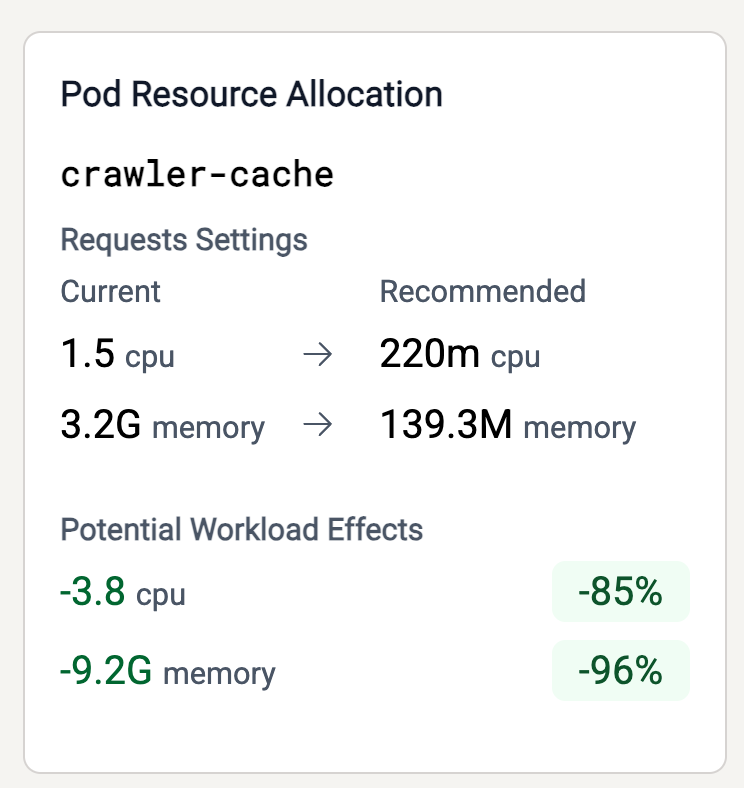
You can view the suggested requests and their projected effects on your workload
in the Thoras dashboard under Resource Allocation Settings.
 ## Next Steps
* Change `spec.vertical.mode` to `autonomous` if you want Thoras to
automatically apply recommendations.
* Add optional `scaling_behavior` if you want to fine-tune the thresholds Thoras
uses to determine if a recommendation is worth restarting the entire workload.
```yaml ast.yaml theme={null}
...
vertical:
mode: autonomous
# Only restart workload if a new resource recommendation is at least 50% greater or lower than the current pod resource allocation
scaling_behavior:
scale_up:
type: percent
percent: 50
scale_down:
type: percent
percent: 50
...
```
## Autonomous Mode
The Thoras Reasoning Engine will make usage predictions on the interval set by
`spec.model.forecast_interval` for the length of `spec.model.forecast_blocks`. If no
`spec.vertical.scaling_behavior` is set then Thoras will check all resource
requests to determine if they match the current suggestion. If any resource
request differs from the current suggestion, Thoras triggers a rollout restart
of the workload. As the pods restart, their resource requests and limits will be
updated to match the suggestion made by Thoras.
> **Note:** Thoras mutates the resource requests and limits of running pods
> directly. It does **not** modify the Deployment or StatefulSet object itself.
> **Note:** Only one scaling direction (horizontal or vertical) can be in
> `autonomous` mode at a time. See
> [Configuring AIScaleTargets](./configuring-asts#understanding-vertical-and-horizontal-scaling-modes)
> for additional details.
## Next Steps
* Change `spec.vertical.mode` to `autonomous` if you want Thoras to
automatically apply recommendations.
* Add optional `scaling_behavior` if you want to fine-tune the thresholds Thoras
uses to determine if a recommendation is worth restarting the entire workload.
```yaml ast.yaml theme={null}
...
vertical:
mode: autonomous
# Only restart workload if a new resource recommendation is at least 50% greater or lower than the current pod resource allocation
scaling_behavior:
scale_up:
type: percent
percent: 50
scale_down:
type: percent
percent: 50
...
```
## Autonomous Mode
The Thoras Reasoning Engine will make usage predictions on the interval set by
`spec.model.forecast_interval` for the length of `spec.model.forecast_blocks`. If no
`spec.vertical.scaling_behavior` is set then Thoras will check all resource
requests to determine if they match the current suggestion. If any resource
request differs from the current suggestion, Thoras triggers a rollout restart
of the workload. As the pods restart, their resource requests and limits will be
updated to match the suggestion made by Thoras.
> **Note:** Thoras mutates the resource requests and limits of running pods
> directly. It does **not** modify the Deployment or StatefulSet object itself.
> **Note:** Only one scaling direction (horizontal or vertical) can be in
> `autonomous` mode at a time. See
> [Configuring AIScaleTargets](./configuring-asts#understanding-vertical-and-horizontal-scaling-modes)
> for additional details.